
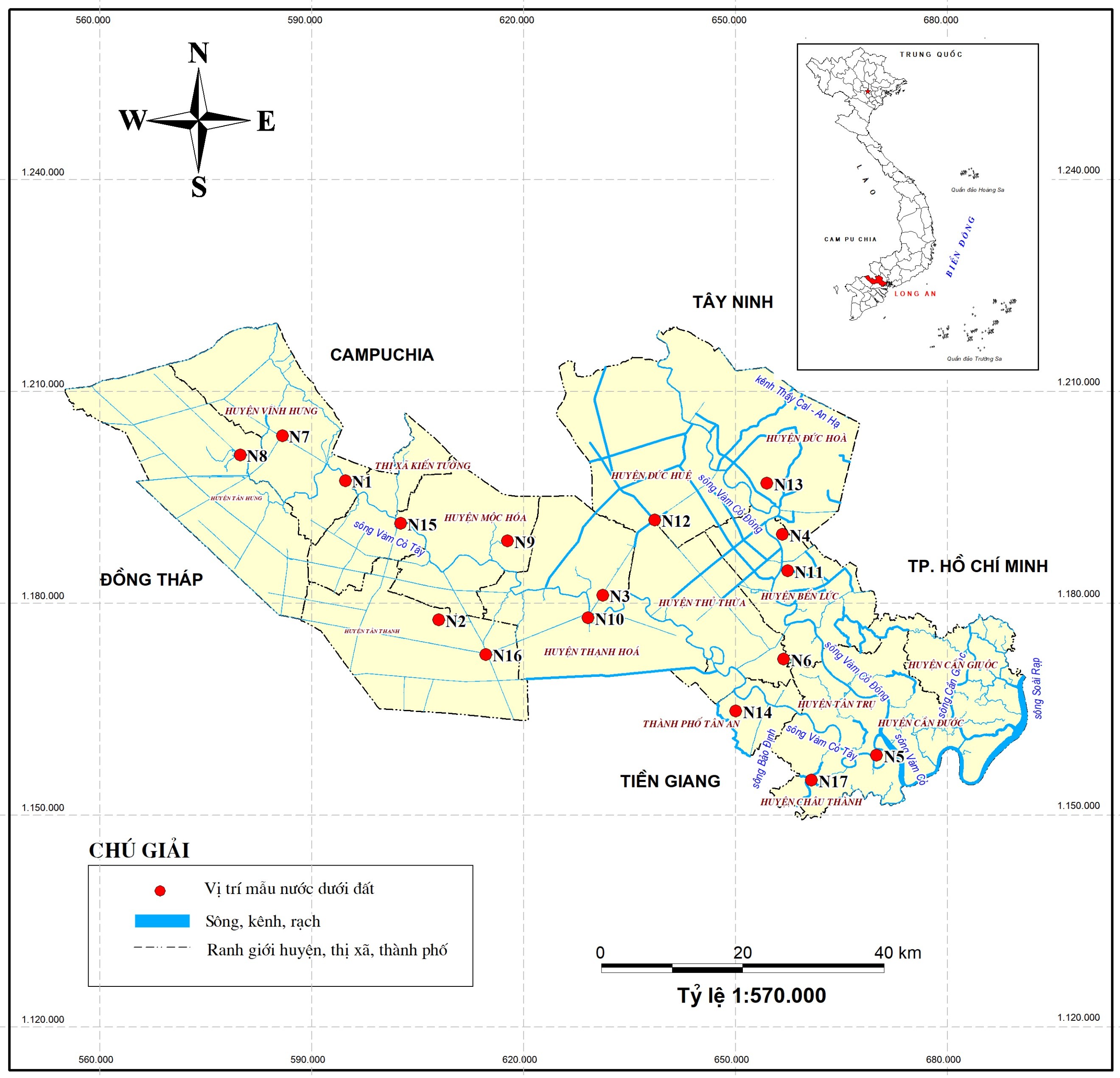


Assessment of groundwater quality using the Groundwater Quality Index (GWQI), and Human Health Risk in the main aquifer (Pliocene) used for domestic water supply in the Long An province (former administrative boundaries)
- author
- Institute of Environmental Science, Engineering and Management, Industrial University of Ho Chi Minh City, Ho Chi Minh City, Vietnam
Abstract
This study aims to systematically evaluate the evolution of groundwater quality, identify key governing factors, and quantify cumulative health risks within the Pliocene aquifer in Long An Province (former administrative boundaries), Vietnam. Data from 170 groundwater samples collected between 2019 and 2023 were analyzed using descriptive statistics, multivariate analysis (PCA/FA), the Groundwater Quality Index (GWQI), and a Mixed-Effects Model. The results indicate an average GWQI of 65 (classified as “Good”); however, significant spatial and temporal variations in water quality were observed. The Mixed-Effects Model revealed a statistically significant (p < 0.05) low-amplitude decline in water quality during the 2022–2023 period and between seasons (with lower GWQI in the dry season compared to the rainy season), suggesting limited self-protection and stability of the deep Pliocene aquifer against surface fluctuations. Iron (Fe) and Manganese (Mn) concentrations exceeded the QCVN 01-1:2024/BYT standards extensively (70% and 32% of samples, respectively). PCA/FA identified four principal components, with Mineralization/Saline Influence (PC1) and Reduction/Metal Release (PC2) as the primary governing processes. Sensitivity analysis of the GWQI via multiple regression confirmed that Total Dissolved Solids (TDS) (59.95%), Fe (19.25%), and Mn (7.78%) are the main factors contributing to water quality degradation. Regarding health risks, the total non-carcinogenic hazard index (HI) for both adults and children remained below the safety threshold of 1.0. However, the carcinogenic risk (CR) associated with Arsenic (As) exceeded the unacceptable threshold (>1×10⁻⁴) at 18% of sampling sites for adults and 24% for children, despite low average Arsenic concentrations. The study concludes that groundwater quality in the Pliocene aquifer is predominantly governed by natural geochemical processes, with the most significant challenges being Fe, Mn, and localized Arsenic risks.