
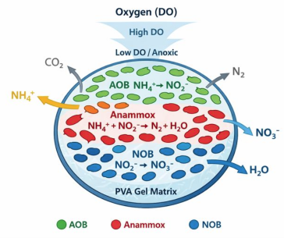


Application of PVA gel beads for immobilization of AOB and Anammox biomass in nitrogen treatment of domestic wastewater
- Faculty of Environment and Natural Resources, Ho Chi Minh City University of Technology, Vietnam National University Ho Chi Minh City, Ho Chi Minh City, Vietnam
- Faculty of Civil Engineering, Ho Chi Minh City University of Technology, Vietnam National University Ho Chi Minh City, Ho Chi Minh City, Vietnam
- Asian Water Research Center (CARE), Ho Chi Minh City University of Technology, Vietnam National University Ho Chi Minh City, Ho Chi Minh City, Vietnam
Abstract
This study evaluated the performance of a single-stage autotrophic nitrogen removal (SANR) system using polyvinyl alcohol (PVA) gel beads to immobilize ammonia-oxidizing bacteria (AOB) and anammox biomass for treating low-C/N domestic wastewater. A laboratory-scale reactor (working volume 10.8 L) was operated under intermittent aeration, with dissolved oxygen (DO) maintained between 0.1 and 0.8 mg/L. The influent ammonium concentration ranged from 50 to 60 mg NH₄⁺-N/L, and the nitrogen loading rate (NLR) was gradually increased from 0.06 to 0.34 kgN/m³/day by reducing the hydraulic retention time (HRT) from 28.8 to 4.8 h. At an NLR of 0.34 kgN/m³/day (HRT 4.8 h), the average ammonium removal efficiency was approximately 90%, while total nitrogen (TN) removal averaged 53%. Nitrite accumulation occurred during transitional operational phases, with peak NO₂⁻-N concentrations exceeding 40 mg/L, coinciding with reduced TN removal. Batch activity tests showed that AOB activity (46.2–75.7 mg NH₄⁺-N/g VSS/day) was consistently higher than NOB activity (3.1–7.1 mg NO₃⁻-N/g VSS/day), indicating effective suppression of nitrite-oxidizing bacteria. The specific anammox activity increased from 46.5 to 89.8 mg N₂-N/g VSS/day as the NLR increased, but tended to level off at higher loading rates. The results demonstrate that SANR with PVA gel beads can sustain partial nitritation and anammox under low-strength domestic wastewater conditions at short HRT. However, nitrite accumulation and operational disturbances significantly affected nitrogen removal performance, highlighting the need for improved control of DO and nitrite/FNA levels. These findings provide quantitative insights into the potential and limitations of SANR–PVA gel systems for mainstream domestic wastewater treatment.