


Optimizing nutrient and light regimes for shrimp pond wastewater treatment by Spirulina platensis in high-rate algal ponds
- Faculty of Environment, University of Science, VNUHCM, Vietnam
- Viet Nam National University, Ho Chi Minh City, Vietnam
Abstract
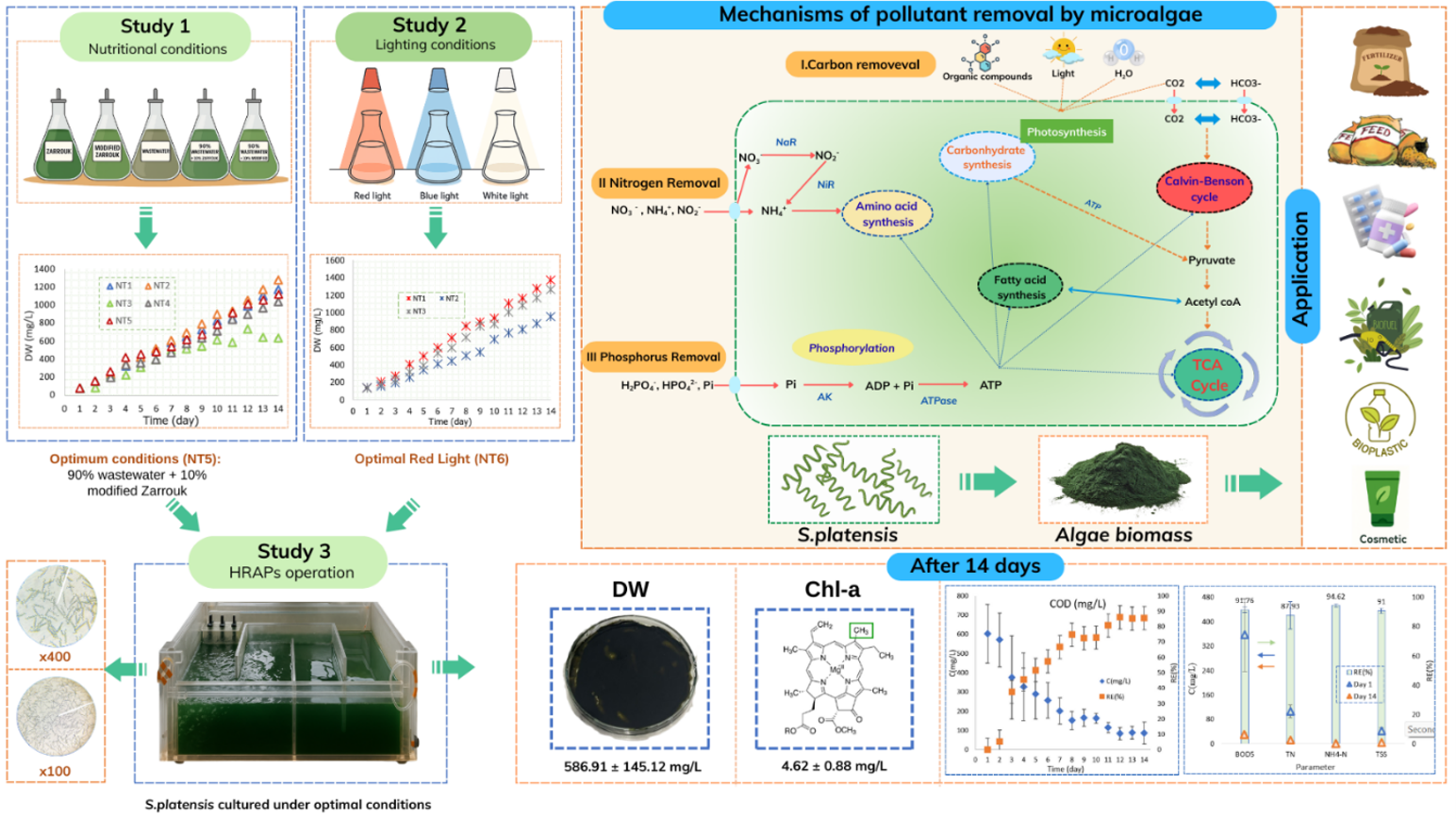
Wastewater pollution from shrimp aquaculture poses a significant environmental challenge, necessitating effective and sustainable treatment solutions. This study aimed to optimize the shrimp pond wastewater treatment capacity of Spirulina platensis (S.platensis) in High-Rate Algal Ponds (HRAPs) through the combined application of nutrient supplementation and light enhancement. The results demonstrated that the modified Zarrouk medium had yielded the highest growth performance, achieving a dry weight of S.platensis (DW) of 1123.43 + 10.10 mg/L on day 14. Red light exceeded the performance of blue and white light, resulting in a DW of 1371.52 + 15.76 mg/L, specific growth rate (SGR) of 0.18 + 0.01 day⁻¹, doubling time (DT) of 3.93 + 0.21 days, and biomass productivity (BP) of 94.87 + 3.52 mg/L/day (p < 0.05). The HRAPs system, operated under red light and supplemented with modified Zarrouk medium, achieved removal efficiencies for chemical oxygen demand (COD) 85.44 + 10.84%, biochemical oxygen demand (BOD5) 91.76 + 1.82%, total phosphorus (TP) 92.59 + 6.43%, total nitrogen (TN) 89.10 + 8.31%, nitrate nitrogen (NO3--N) 87.93 + 9.32%, ammonium (NH4+-N) 94.62 + 1.12%, total suspended solids (TSS) 91.00 + 1.77%, and Coliforms 99.99 %. The S.platensis biomass effectively absorbed nutrients in its growth from a culture medium combining shrimp pond waste and heterotrophic microbial community. Biomass production of S.platensis reached a DW of 586.91 + 145.12 mg/L and chlorophyll a of 4.62 + 0.88 mg/L after 14 days. The findings also suggest that The HRAPs system utilizing S.platensis not only provides high wastewater treatment efficiency but also promotes green technology, supporting a circular economy through the reuse of algal biomass for agricultural and energy purposes. The results confirm the potential of HRAPs under optimized conditions as a sustainable, environmentally friendly solution for aquaculture wastewater treatment, with prospects for large-scale implementation (Figure 1).