


Performance comparison of conventional biological treatment process and membrane bioreactor treating common industrial effluent
- Ho Chi Minh City University of Technology (HCMUT), Vietnam
- Ho Chi Minh City University of Technology (HCMUT)
- Ho Chi Minh City University of Industry and Trade (HUIT)
- Ho Chi Minh City University of Technology and Education
Abstract
Industrial effluent is challenging for wastewater treatment plants due to its complexity, toxicity and variable composition. This study aimed to evaluate the efficiency of industrial wastewater treatment between a lab-scale membrane bioreactor (MBR) and a full-scale anoxic/oxic (A/O) process. The wastewater used was after primary sedimentation tank, which involved lime or ferric coagulant. The results showed that the treated water quality from both systems was satisfied the national effluent standard for wastewater (column B of QCVN 40-MT:2011/BTNMT). The effluent from A/O process contained 74 ± 11 mg/L of COD, 8.3 ± 1.9 mg/L of TN, 1.6 ± 0.6 mg/L of TP, and 201± 38 Pt-Co of color. Meanwhile, the concentrations of COD, TN, TP, and color in the effluent of MBR system were 88 ± 21, 23.2 ± 4.6, 0.3 ± 0.2 mg/L, and 220 ± 98 Pt-Co, respectively. The removal rates of COD, TN, TP and color of anoxic/oxic process were 234 ± 119, 16 ± 3, 0.3 ± 0.2 mg/L.day, 213 ± 58 Pt-Co/L.day, respectively. The removal rates of COD, TN, TP, and color in MBR system were 1.6, 1.3, 10.3, and 2.1 times higher than those in the A/O process, respectively. Although the A/O process in industrial zones performed well, the MBR system demonstrated higher removal rates, particularly for nutrient removal. Besides, MBR systems offer several advantages, including reduced excess sludge production and less space requirements compared to A/O process. In general, MBR offers a promising solution for industrial wastewater treatment, with strong potential for application in industrial zones.
Introduction
Clean water resources in Vietnam are threatened due to the rapid economic expansion and the discharge of most untreated industrial wastewater to water bodies 1. Industrial parks in Vietnam have been widely developed, leading to the emergence of many factories with various production processes. The industrial fields generating toxic wastewater including textile and dyeing, pharmaceutical production, paper, and printing 2. This increases the danger of polluted water sources as a result of discharge from industrial zones (IZs) 3. More than 400 industrial parks are throughout the country as of July 2024, which discharge about 3 million m/d wastewater 1. Since 2009, all industrial wastewater from IZs must be collected and treated at a central wastewater treatment plant (WWTP), and the treated wastewater must meet Vietnam's national technical regulation on industrial wastewater, QCVN 40:2011/BTNMT 4. In 2018, 88% of the IZs had WWTP, and 71% of the wastewater was treated for at least some parameters such as COD, heavy metals 4. Large volumes of wastewater, including hazardous heavy metals, phenolic organic compounds, and other persistent organic pollutants, are released by major polluting industries including the textile, paper, printing, and dyeing sectors 2. Industrial wastewater contains a variety of substances at varying concentrations, treating industrial wastewater is a complicated process. Pre-treatment, primary, secondary, and tertiary, refining, and purification are the categories into which they are generally accepted in industrial wastewater treatment 5. For industrial wastewater treatment, physical processes, e.g., screening, filtration, sedimentation, and membrane filtration. The primary treatment methods comprised precipitation, ion exchange, adsorption, photocatalysis, and electrochemical process. Different technologies are used to treat industrial wastewater which has their pros and cons. The precipitation methods are cost-effective (low cost and easy for operation with mostly metals can be removed). However, this method generates a large amount of sludge, leading to complications in management. On the other hand, ion exchange technology includes material regeneration and its selective property for metal ions. In contrast, the drawbacks of this method are the limited number of metal ions available and the high cost 6. In terms of electrochemical method, it can remove most of the metals with no chemical consumption. Electrodialysis method is high separation efficiency with low chemical use. However, these methods have high operational costs due to energy consumption. Furthermore, membrane fouling in electrodialysis also leads to additional operational cost 6.
As a result, biological wastewater treatment is preferred for industrial wastewater due to its low energy consumption, high efficiency, and ability to overcome the limitations of other conventional approaches 7. Membrane biological reactors are one of the alternative methods available for wastewater treatment. Membrane bioreactor technology (MBR) combines biological treatment and membrane filtration to provide advanced wastewater treatment with activated sludge and attached growth are two biological processes. Membrane filtration in MBRs separates microbes and degraded substances, improving efficiency and selectivity. It has potential for generating quality effluent and treating industrial wastewater, such as fish canning, protecting water resources and promoting water reuse. MBRs can reduce certain pollutants, such as the diclofenac metabolite four-hydroxy diclofenac. The MBRs would be a good selection for industrial wastewater treatment. Longer sludge retention time (SRT) increases the concentration of the activated sludge, resulting in high-efficiency 8. The improved membrane filtration and biological degradation make the effluent quality good and steady, smaller footprint, low chemical consumption are also advantages of MBR. However, the main disadvantage of MBR technology is membrane fouling and the inability to remove micropollutants because the membrane pore size used in MBR technology cannot trap them. This study aims to investigate the treated effluent qualities of the anoxic/oxic process (A/O process) and membrane bioreactor (MBR), seeking to determine which method is more effective and sustainable for industrial wastewater treatment. By comparing these technologies, the research provides valuable insights for industries in selecting the most appropriate treatment method based on performance, energy consumption and environmental impact.
MATERIALS AND METHODS
Central wastewater treatment plant (A/O process) at an industrial zone
The central wastewater treatment plant (WWTP) was investigated with a design capacity of about 4000 m/d. The main biological treatment technology is anoxic/oxic process (A/O process). The main industrial factories include dyeing and textile, mechanical engineering, leather and footwear, food processing, electro-plating industries. Most factories have their own pre-treatment system that meet the industrial zone’s standards (TCVN 5945:2005, Column C) before discharging into WWTP respondsible for treating the entire zone’s wastewater.
The WWTP includes main treatment processes such as equalization tank (EQ), primary physicochemical process (PC1), anoxic/oxic process (A/O), secondary physicochemical process (PC2), and disinfection.
The WWTP was operated at an organic loading rate (OLR) of 0.48 kgCOD/m.d. The hydraulic retention time (HRT) was 1.89 days, and sludge retention time (SRT) is 22.5 days.
Lab-scale membrane bioreactor system (MBR)
The wastewater used in this study was taken from after 1 physical-chemical process (PC1) of a central wastewater treatment plant. The pH of wastewater ranged from 7.1 to 8.3. The color concentration was 171 - 414 Pt-Co while the TSS, COD, TN, and TP concentrations were in range of 24 - 184, 141 - 480, 25.27 - 40.24, and 0.25 - 0.81 mg/L, respectively (Table 1).
Characteristics of Influent wastewater
|
Parameters |
Unit |
Value |
QCVN 40:2011/BTNMT, Column B |
|
pH |
7.1 – 8.3 |
5.5 – 9 | |
|
TSS |
mg/L |
24 - 184 |
100 |
|
COD |
mg/L |
141 – 480 |
150 |
|
TN |
mg/L |
25.27 – 40.24 |
40 |
|
TP |
mg/L |
0.25 – 0.81 |
6 |
|
Color |
Pt-Co |
171 – 414 |
150 |
A lab-scale system of membrane bioreactor (MBR) with a volume of 10.5 L (0.30 m length x 0.07 m width x 0.50 m height) in which the working volume is 8.0 L. The polyethersulfone (PES) flat sheet membrane with a surface area of 0.05 m and pore size of 0.1 µm was supplied by MARTIN Membrane system Co. Ltd (Germany). MBR was operated at an organic loading rate (OLR) of 0.54 kgCOD/m/d. The permeate flux and hydraulic retention time (HRT) of MBR were 6.0 L/m/h (LMH) and 12.8 h, respectively. Permeate pump operation was cyclic (6 minutes-filtration, 4 minutes-relaxation). The digital pressure gauge was installed to daily record the transmembrane pressure (TMP). The sludge retention time (SRT) was maintained at 20 days during operation.
Analytical methods
The parameters of Total Suspended Solid (TSS), Chemical Oxygen Demand (COD), color, Total Nitrogen (TN), and Total Phosphorus (TP) were analyzed following methods in Standard Methods 9. Besides, pH value was monitored with a portable meter HI 9813–6 (Hana, Romania)
RESULTS AND DISCUSSION
Treatment performance A/O process and MBR system
The results clearly present a detailed comparison of treatment performance between the A/O process and MBR, focusing on three factors: organic compounds (COD), nutrients (total nitrogen and total phosphorus), and other parameters (pH and color) show in Figure 1. Table 2 provides the removal rate for these parameters in both system.
Removal rates of main parameters in A/O process and MBR system
|
Parameters |
Unit |
Removal rate | |
|
A/O process |
MBR | ||
|
COD |
mg/L/day |
234 ± 119 |
378 ± 147 |
|
TN |
mg/L/day |
16 ± 3 |
20 ± 8 |
|
TP |
mg/L/day |
0.3 ± 0.2 |
3.1 ± 1.4 |
|
Color |
pt-co/L/day |
213 ± 58 |
100 ± 120 |
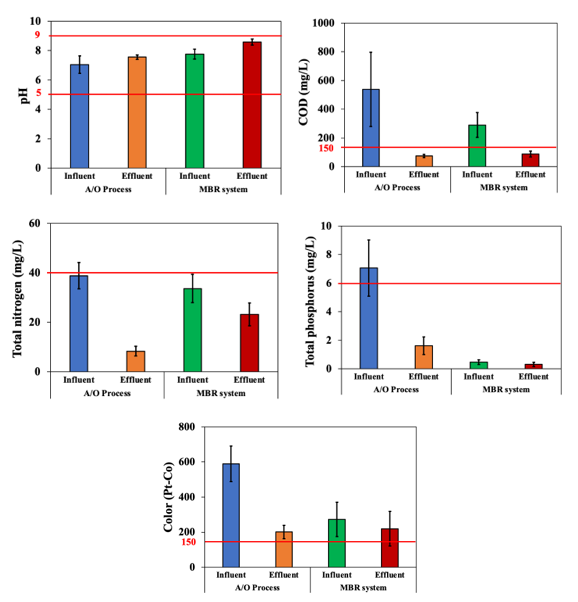
Water quality parameters of A/O process and MBR system: pH, COD, total nitrogen, total phosphorus, and color
COD removal
The removal of organic compounds exhibited significant differences between the A/O process and MBR systems. In the A/O process, COD levels dropped from 539 ± 258 mg/L to 74 ± 11 mg/L, corresponding to a removal rate of 234 ± 119 mg/L/day. On the other hand, the MBR system achieved a more efficient removal rate of 378 ± 147 mg/L/day, with COD concentration decreasing from 290 ± 86 mg/L to 88 ± 21 mg/L. Although COD content in the effluent when of the MBR system was slightly higher than that of the A/O process, the COD removal rate in the MBR was significantly higher, indicating its ability to remove organic compounds in a shorter time frame. It is worth noting that the COD concentrations in the output is always under standard value for COD in wastewater treatment (QCVN 40-MT:2011/BTNMT, Column B) of 150 mg/L. A research by Lastre-Acosta et al. 10 on industrial wastewater treatment using an MBR system found that the effluent COD level remained below 197 mg/L, even when treating influent COD concentrations of 1739.6 ± 567.4 mg/L under high permeate flux conditions and a hydraulic retention time of 12 h. Another study showed that within 24 hours of hydraulic retention time, COD concentration sharply decreased from 4061 mg/L to 128 mg/L when using the MBR system 11. Thanh et al.12 evaluated the the treatment efficiency of an MBR combined with Powder-Activated Carbon (PAC) and Alum for treating diluted dyeing and textile wastewater. The influent COD concentration was maintained at 500–650 mg/L, with an SRT of 60 days. Results revealed that without PAC or Alum, COD content was decreased to 227 ± 67 mg/L. However, the addition of PAC or Alum improved the stability and efficiency of COD removal in the MBR system. Effluent COD level dropped to 75 ± 26 mg/L and 73 ± 18 mg/L in cases of MBR-PAC and MBR-Alum operations, respectively. In a study conducted by Jegatheesan et al. (2015), it has been shown that aerobic membrane bioreactor (AeMBR) can treat wastewater with COD and BOD ranging from 500 to 6000 mg/L and 90 to 1375 mg/L, respectively. The result shows high COD removal efficiency of 50 – 98% 13.
Nutrients removal
The removal of nutrients, particularly total nitrogen (TN) and total phosphorus (TP), also showed differences in performance between the two systems. Regarding TN, the A/O process reduced concentrations from 38.8 ± 5.3 mg/L to 8.3 ± 1.9 mg/L, achieving a removal rate of 16 ± 3 mg/L/day. The MBR system, although contained higher effluent TN level (23.2 ± 4.6 mg/L), demonstrated a faster removal rate of 20 ± 8 mg/L/day. This indicates that the MBR could be more efficient in nitrogen removal within a shorter time frame. Singh and Thomas 14 conducted an MBR study on domestic wastewater, where influent ammonia-nitrogen levels ranged from 25 to 30 mg/L with an HRT of 9 hours. After 10 days of operation, the concentration of ammonia-nitrogen was reduced to 0.7 – 1.4 mg/L. Belli et al.15 observed that TN level in the effluent of MBR system was dropped to below 15 mg/L, while the influent TN concentration was 67 ± 10 mg/L with an SRT of 80 d. Kitanou et al. 16 reported that, with the influent TN mean concentration of 54 mg/L, the TN was decreased to 24.5 mg/L in the A/O process and to 4 mg/L in the MBR effluent within 15 hours of hydraulic retention time. These results also indicated higher TN removal efficiency was performed by the MBR system. This performance of the MBR system in TN removal could be attributed to both the hydrolysis of accumulated particulate organic matter and the disintegration of cells, processes that occur during nitrification and denitrification 17.
In terms of TP removal, the A/O process reduced TP levels from 7.1 ± 2.0 mg/L to 1.6 ± 0.6 mg/L, achieving a modest removal rate of 0.3 ± 0.2 mg/L/day. In comparison, the MBR system has better performance on TP removal with a higher removal rate of 3.1 ± 1.4 mg/L/day, reducing TP level from 0.5 ± 0.2 mg/L to 0.3 ± 0.2 mg/L. A previous study revealed that with an influent TP concentration of 8.5 mg/L, the A/O process lowered TP content to 2.5 mg/L, while the effluent TP level in MBR system was found at lower level of 1.6 mg/L 3. The results of nutrients removal revealed the MBR system’s potential for more efficient removal of both TN and TP from wastewater. Belli et al. 15 investigated TP removal in municipal wastewater using a sequencing batch membrane bioreactor, where TP concentration decreased from 7.1 ± 1.5 mg/L to 4.7 ± 2.8 mg/L, with an SRT of 80 days.
Color removal
The change of pH and color after operation of the A/O process and MBR system
|
A/O process |
MBR | |||
|
Influent |
Effluent |
Influent |
Effluent | |
|
pH |
7.0 ± 0.6 |
7.6 ± 0.2 |
7.8 ± 0.3 |
8.6 ± 0.2 |
|
Color |
590 ± 101 (Pt-Co) |
201 ± 38 (Pt-Co) |
273 ± 98 (Pt-Co) |
220 ± 98 (Pt-Co) |
Color removal varied significantly between the two system. The A/O process reduced color from 590 ± 101 Pt-Co to 201 ± 38 Pt-Co, corresponding to a removal rate of 213 ± 58 Pt-Co/L.day. In contrast, the MBR system, with a lower removal rate of 100 ± 120 Pt-Co/L.day, dropped color from 273 ± 98 Pt-Co to 220 ± 98 Pt-Co. As a result, A/O process achieves a higher color removal rate than the MBR system. In the anoxic stage, denitrification occurs, where COD serves as the electron donor. Meanwhile, nitrate (NO) and nitrite (NO) act as alternative electron acceptors. During this process, bacteria utilize the organic matter in the wastewater to generate energy for growth and metabolism. The carbon source act as a co-substrate that is metabolized to generate reducing equivalents (electrons). These electrons interact with dye and break down the azo bond, which is responsible for the dye’s color. This reaction effectively decolorizes the wastewater, contributing to the superior color removal performance of the A/O process 18. A study by Thanh et al. 12 assessed the color removal efficiency of an MBR system combined with PAC and Alum for treating dyeing and textile wastewater. The color in the influent ranged from 250 to 2350 Pt-Co, with a HRT of 10.5 to 11.5 h. The effluent color was 987 ± 377 Pt-Co for the MBR system alone, but improved to 333 ± 163 Pt-Co and 174 ± 132 Pt-Co with the addition of PAC and Alum, respectively.
pH
Table 3 presents the pH changes after treatment of the A/O process and MBR system. The pH level in the A/O process increased from 7.0 ± 0.6 to 7.6 ± 0.2, while the MBR system exhibited a more significant rise from 7.8 ± 0.3 to 8.6 ± 0.2. Although both systems maintained effluent pH levels within an acceptable range, the higher pH in the MBR system might require further adjustment it meets specific discharge criteria.
Energy consumption
Specific electricity demand (SED) of A/O process and MBR system
|
Operational conditions |
Specific electricity demand (SED) (kWh/m3) |
Reference | |
|
A/O process |
Flow rate: 4000 m3/day |
0.28 |
|
|
MBR |
F = 20 LMH |
0.19 |
|
|
F = 25 LMH |
0.01 |
| |
|
Full-scale |
0.2 - 3.0 |
Table 4 illustrates the different specific electricity demand (SED) between A/O process and MBR system under various operational conditions. For the A/O process in the industrial zone with a flow rate of 4000 m/day, the SED was 0.28 kWh/m, as reported by Sabelfeld et al. 1. The MBR systems exhibited a wider range of SED values depending on operational factors, such as system scale, pre-treatment, and flux. Nguyen et al. 19 found that an MBR system operating at flux of 20 LMH required 0.19 kWh/m, while Bae et al. 20 reported a significant lower SED of 0.01 kWh/m at 25 LMH. In full-scale applications, the SED varies more broadly, ranging form 0.2 to 3.0 kWh/m, highlight the influence of scale and operational conditions on energy consumption in these wastewater treatment system. In conclusion, the MBR system demonstrates good performance in the removal of COD, TN, and TP, achieving higher removal rates compared to the A/O process. Despite minor variations in effluent quality, the MBR system is more effective at processing these pollutants in a shorter time frame, as seen in several studies. Furthermore, the MBR system’s lower specific electricity demand (SED) under certain operational conditions suggests that it may also offer energy savings. Therefore, MBR system presents a promising, energy-efficient alternative for high-efficiency wastewater treatment.
Strengths and Challenges
Based on above mentioned, MBR can be a promising method for industrial wastewater treatment and provide stable high-quality treated water. Jijingi et al. 21 demonstrated that MBR technology has been an appropriate approach to improving industrial wastewater quality in developing countries where industrial wastewater is becoming more challenging. Based on this study and previous studies, MBR technology is qualified to remove ordinary pollutants (COD, TN, TP, TSS, and color), suspended solids, oil, grease, even microplastics, heavy metals, pathogens, and emerging pollutants 1, 21, 22. Then, high-quality effluents from MBR technology can satisfy discharge regulations and be utilized for various reuse purposes. In addition, MBR technologies are compact and modular systems so they are a suitable choice for densely populated areas with limited space 21. Sludge production from MBR technologies has also been reduced to less than that of conventional processes. MBRs offer valuable economic benefits through reduced water consumption, lower environmental impact, and potential revenue from treated water reuse 21.
However, MBR has some obstacles in the operating period: such as membrane fouling, energy consumption, capital, and operational cost 23. Energy used in MBR is mainly consumed for aeration (membrane scouring and biological aeration), liquid pumping (lifting and recirculation), sludge mixing, and so forth. Based on the optimization level, size, and operating conditions of the plant, the average energy requirement for MBR operation ranges from 0.4 to 2.3 kWh/m of treated effluent 13. The capital and operating expenses of MBR are still higher than those of conventional activated sludge without tertiary treatment though comparable to conventional activated sludge with tertiary treatment 23. Membrane fouling is a significant obstacle in MBR systems. Membrane fouling is mostly a reason for causing energy consumption and affecting the long-term stability of MBR. Improvements in membrane fouling resistance and longevity have led to higher treatment performance, fewer maintenance requirements, and lower operational cost 21, 23. Managing these difficulties is thus critical to ensuring the stable, efficient, and long-term operation of MBR systems and their full-scale applicability.
Conclusions
In this study, the performance of a full-scale anoxic/oxic (A/O) process in industrial zones and a lab-scale membrane bioreactor (MBR) system was evaluated for industrial wastewater treatment. The results demonstrated that both systems were effective in reducing pollutants to levels compliant with former national effluent standard (TCVN 5945:2005, Column C). However, the MBR system exhibited significantly higher removal rates for COD, TN, TP, and color compared to the A/O process, particularly in nutrient removal. It is suggested that MBR system holds great promise as an industrial wastewater treatment solution due to its advantages of stable, high-quality effluent, less space requirement, and low sludge production. However, challenges such as membrane fouling, high operational costs, and limited micropollutant removal must be solve to fully optimize MBR technology for larger-scale applications.
LIST OF ABBREVIATIONS
IZs: industrial zones
WWTP : central wastewater treatment plant
MBR: Membrane bioreactor
A/O: anoxic/oxic process
SED: specific electricity demand
PAC: Powder-Activated Carbon
SRT: sludge retention time
EQ: equalization tank
PC1: primary physicochemical process
PC2: secondary physicochemical process
PES: polyethersulfone
Acknowledgements
This research is funded by Vietnam National University Ho Chi Minh City (VNU-HCM) under grant number NCM 2021-20-01.
Competing Interests
The authors declare that they have no conflict of interest.
Authors' Contributions
Sampling, sample analysis, investigation, software, writing - original draft, writing - review & editing: Cong-Sac Tran, Pham-Yen-Nhi Tran, Thi-Yen-Phuong Nguyen, Mai-Nhu Hoang;
Data curation, conceptualization, methodology, writing - review & editing: Phuong-Thao Nguyen, Quang-Huy Hoang, Mai-Duy-Thong Pham; Thi-Tuyet-Nhung Hoang, My-Le Du
Supervision, conceived, designed the methodology, writing - review & editing: Thi-Kim-Quyen Vo, Xuan-Thanh Bui.