


Nutrients recovery from urine through struvite formation using lab-scale fluidized-bed homogeneous crystallization reactor
- Faculty of Environment and Natural Resources, Ho Chi Minh City University of Technology (HCMUT), VNU-HCM, Ho Chi Minh City 700000, Vietnam
- Key Laboratory of Advanced Waste Treatment Technology, Vietnam National University Ho Chi Minh (VNU-HCM), Linh Trung Ward, Thu Duc City, Ho Chi Minh City 700000, Vietnam
- Faculty of Environmental and Food Engineering, Nguyen Tat Thanh University, Ho Chi Minh City 700000, Vietnam
- Department of Chemical Engineering, National Cheng Kung University, Tainan 71710, Taiwan
Abstract
Phosphorus (P) is considered the most important micro-element needed for every living thing. Even though they have limited amount, P and nitrogen (N) are responsible for eutrophication in water bodies. This paper aimed to give an insight into the removal efficiency of nutrients and struvite crystallization of slowly soluble fertilizer MgNH4PO4.6H2O, which is also called NH4+-struvite. Besides, using fluidized bed homogeneous crystallization (FBHC) system can reduce impurities in granular struvite generated during the reaction as the advantage function itself. The results showed the changes in pH, magnesium (Mg2+), phosphate (PO43--P), ammonium (NH4+-N), and appearance of spontaneous struvite precipitation over time. Using synthesis urine sample with adjusted pH and Mg2+ concentration to determine the optimal conditions for granular NH4+-struvite recovery to maintain Mg and P removal efficiency up to 99% in steady state. In this study, the removal efficiency of N was about 80 – 85% maximum. The initial results indicated the feasibility of simultaneous crystallizing NH4+-struvite which is mentioned above. It could easily form at pH around 8 – 9. On the other hand, urea hydrolysis makes a pH increase in urine from 6.5 to less than 9.0 at room temperature. This might cause a heavy impact on the NH4+-N crystallization during the formation of granular struvite if there has no suitable NH4+-N pretreatment options. For Mg recovery, the concentration of Mg is detrimental in the creation of struvite. This will bring better removal efficiency if there is an available Mg source in nature which can be reused directly in an environmentally eco-friendly way. The total mass of struvite precipitate obtained in the form of nuclei corresponds to 200 g/m3 of urine during 24 days operation.
INTRODUCTION
The phosphate fertilizer industry is now facing many problems where the main reason is due to its overreliance on phosphorite ore mining and phosphorus (P) resources which are expected to be exhausted in the next 100 years1, 2. Besides, chemical compounds containing nitrogen (N) and P, which are abundant in fertilizers, are quite serious pollutants for the environment such as: 20 kg and 138 kg of COD will be released by 1 kg of N and P respectively while COD is well-known as the form of dead algae causing eutrophication of water sources3. This problem increases when urban residents are increasing, as their waste is currently not recycled4. Together with the recovery of eutrophication, these issues have caught more attention for research5.
From the dual pressure of controlling eutrophication and facing the supply of P for the fertilizer industry, many studies have focused on developing different solutions to recover P from wastewater. In domestic wastewater, urine accounts for 1% of wastewater but about 80% of N, 50% of P and 60% of potassium (K) 6, 7. Human urine and municipal wastewater are the two main sources of nutrients for P recovery with the specific concentration described in Table 1. Urine accounts for 50 – 80% of P, 85 – 90% of N and 80 – 90% of K but little more than 1% by volume in domestic wastewater8. It is estimated that a total of 1,680,000 tons of P could be recovered from the urine in 2009, representing about 11% of the total global P requirement9.
Raw urine characteristics
|
Parameters |
Unit |
Raw urine |
Stored urine |
|
pH |
- |
6.2 |
9.1 |
|
TN |
mg/L |
8,830 |
9,200 |
|
NH4+/NH3 |
mg/L |
460 |
8,100 |
|
NO3- and NO2- |
mg/L |
0.06 |
0 |
|
COD |
mg/L |
6,000 |
10,000 |
|
TP |
mg/L |
800 – 2,000 |
540 |
|
K+ |
mg/L |
2,740 |
2,200 |
|
SO42- |
mg/L |
1,500 |
1,500 |
|
Na+ |
mg/L |
3,450 |
2,600 |
|
Mg2+ |
mg/L |
120 |
0 |
|
Cl- |
mg/L |
4,970 |
3,800 |
|
Ca2+ |
mg/L |
230 |
0 |
Urine is a solution containing complex components such as: sodium chloride (NaCl), urea (CO(NH)) and predominant compounds such as K, calcium (Ca), sulphate (SO) and phosphate (PO) in lower concentrations. Human urine contains an excess of ammonium compared to phosphate but lacks magnesium. Urine usually has a pH between 5.6 and 6.8 and most PO exists below form HPO or HPO11. As a result, one of the most simple and cheapest ways is chemical struvite precipitation, which doesn’t require much for raw materials such as available wastewater sources in daily life. Available waste sources generated a lot of attention to reuse 12. Therefore, the separation of urine at the source to reuse the N, P recovery. Besides, struvite generation is considered as one of the effective solutions for nutrient enrichment, cost reduction for wastewater treatment and generation of natural resources to meet future P source shortages.
Fluidized-bed reactors (FBRs) were increasingly used in the precipitation industry as this method of reactor enables getting through the crystallization of struvite processing 13, 14. It was because the distinction of struvite mechanical advantages and the high contact area between media and wastewater in general or human urine, in particular, can be obtained in the FBR. Moreover, it was able to achieve a low hydraulic retention time (HRT) no more than a day. The mechanism and its thermodynamic characterization would contribute to the further development of P, K removal systems for this new design 15, 16. According to Van-Giang et al. (2019), the fluidized-bed homogeneous crystallization (FBHC) reactor was created as an upgrade of FBRs without using seedings. The FBHC transforms precipitation into high-purity granules that contain less water 15. The FBHC transforms precipitation into high-purity granules that contain less water. The FBHC with the struvite is carried out under moderate supersaturation. In the FBHC, the minimum velocity of fluidization is needed to further optimize the growth of crystallized pellets. The minimum velocity of fluidization is 7.5 m/h for the first 4 – 5 days. It has been calculated in the fluidizing phase based on working volume of the reactor. Besides, the strongest slow-release fertilizers are granular sources of struvite since particle growth by precipitating supersaturated species onto the surface of foreign particles is referred to as heterogeneous crystallization 15. In contrast, homogeneous crystallization happens in the absence of foreign particles, then the grain develops when the nuclei clash in a metastable solution. The additional granulation enlarges the homogeneous particles that have been adequately fluidized in the fluidized-bed homogeneous crystallization process. The granulation process is significantly dependent on the up-flow velocity. So far, fewer researchers have been thinking about the effectiveness of FBHC in removing phosphate through struvite crystallization. Therefore, in this research study, the FBHC will be used to investigate the struvite precipitation from raw human urine as well.
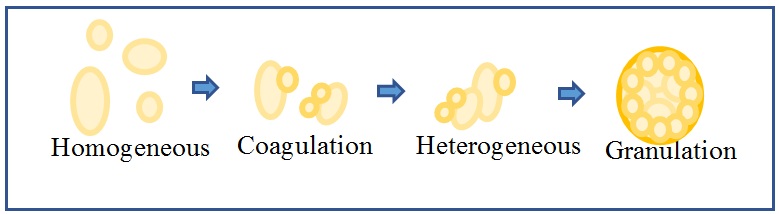
Struvite precipitation mechanism
The two effectively precipitated forms of struvite were NH-struvite and K-struvite. However, the compaction in K-struvite was very weak in naturally deposited urine, and NH-struvite was much higher precipitating than K-struvite, the SEM and XRD tests revealed that pure K-struvite was produced up to 95% by an upgrade of the FBHC model without using any seeding materials 15. On the other hand, before extracting K, most NH should be extracted13. Depending on the diversity and concentration of the ions in the aqueous system and pH of the solution, the precipitation of two types of struvite, especially NH-struvite, could be easier forming18. That is the reason why the pH adjustment of an alternate alkaline compound other than NaOH should be observed where pH was one the most important parameters during struvite creation19, 20. The changing forms of granular struvite are getting through as Figure 1. In granular form, struvite is easier to apply and does not form cakes in wet environments. That is why struvite can be applied to any industrial field just like any other fertilizers. In the world, creating struvite from urine is an interest to many researchers since the removal efficiency and recovery of nutrient from this source is quite high. However, in Vietnam, technologies for creating struvite and recovering N, P from urine are still limited. That's why this study is aimed at nutrients recovery from urine to create struvite using lab-scale fluidized-bed homogeneous crystallization reactor.
MATERIALS AND METHODS
Chemical reagents
All of the reagents were of analytical grade. A standard recipe was used to make the synthetic urine 21, 22. The chemicals were used to prepare the synthetic urine in this study including CaCl.2HO 0.65 g/L, MgCl.6HO 0.65 g/L, NaCl 4.6 g/L, NaSO 2.3 g/L, CHNaO.2HO 0.65 g/L, Na-(COO) 0.02 g/L, KHPO 4.2 g/L, KCl 1.6 g/L, NHCl 1 g/L, NHCONH 25 g/L 22. The characteristics of synthetic urine: pH = 5 – 5.5; NH-N = 261.68 mg/L; PO-P = 957.35 mg/L; Mg = 76.85 mg/L. The important chemicals needed are calcium chloride dihydrate (CaCl.2HO, 96.0%), magnesium chloride hexahydrate (MgCl.6HO, 99.0%), and sodium chloride (NaCl, 99.0%) were from Showa (Japan). We got potassium phosphate monobasic (KHPO, 99.0%), potassium chloride (KCl, 99.0%), and ammonium chloride (NHCl, 99.8%) were obtained from Sigma-Aldrich (U.S.A), etc.
Lab-scale fluidized-bed homogeneous crystallization (FBHC) reactor

Schematic of experimental design of fluidized-bed homogeneous crystallization (FBHC)
The urine sample after measuring and adding the right amount of Mg, P, and K sources will be pumped into the influent line. NaOH solution placed in the right side as in Figure 2 will be pumped directly at the same time with effluent to keep pH low around 9 at first to form precipitation of NH-struvite. Furthermore, using the recirculation flow can help to reuse the nutrients left in the waste stream. The P and N after being kept in precipitation will help the sample have more recovery efficiency than runout in the effluent line. Basic calculation according to measured pumps and parameters in Table 215:
Operational condition for FBHC
|
Parameters |
Quantity |
Unit |
|
Input flow |
10 |
mL/min |
|
Recirculation flow |
30 (first 7 days) 140 (the following days) |
mL/min mL/min |
|
0.2 N NaOH for adjusting pH |
2 |
mL/min |
|
Up-flow velocity |
40 |
m/h |
|
Room temperature |
30 ± 2 |
o C |
|
pH |
8.2 ± 1.2 |
- |
|
Mg:P ratio |
1.25:1 |
- |
|
Hydraulic retention time |
50 |
min |
|
Reactor cycle |
24 – 30 |
days/experiment |
The molar ratio of Mg:P plays an important role in the crystallization of struvite, and the ratio greater than 1 is considered necessary23. At Mg:P = 1, when the pH exceeds 9, the reaction occurs enough to completely remove the P, similar to the amount of precipitated NH-struvite. Furthermore, the NH-N concentration decreases from 41 mg/L to 22 mg/L at equilibrium. This indicates that less than 1% of the PO-P was removed as struvite, the largest percentage probably being K-struvite. With the addition of MgO (Mg:P = 1.5 and 2) the pH further increased, but did not further affect the removal efficiency of P22. The molar ratio of Mg:P added to the urine input sample is usually 1.1 – 1.2. However, according to some studies, the corresponding molar ratio of Mg:P is 2:2 at pH = 10 showed that the P and K removal efficiency of K-struvite was over 75%. That’s why in this study, the ratio of Mg:P = 1.25:1 was applied to synthesis urine sample 23.
All of the analytical parameters were followed from the APHA 2005 standard book 24 as a reference to experiment with the struvite performance. For the synthesis of urine, six parameters needed to test for influent and effluent in this topic included: pH, total hardness, Mg, PO-P, NH-N. Samples were taken once a day in the morning at influent and effluent line. Filtered samples were needed before analyzing.
RESULTS AND DISCUSSION
Efficient treatment of nitrogen and phosphorus in the form of struvite
The pH in the reactor was maintained at around 8 to avoid the appearance of other forms such as MgNHPO, Mg(OH), MgHPO, MgCO, Ca(PO), CaHPO, CaCO precipitation in the reactor 25, 26 because when the pH is higher than 8, the sample produces Mg(OH) precipitation. Currently the reactor is operating at pH around 8. It is noted that pH higher than 11 will create tri-magnesium phosphate 27. Similar to pH, the concentration of Mg input was recorded around 150 mg/L which was much smaller than the concentration of PO-P, 4,000 mg/L, while the operation condition needs the Mg:P molar ratio to be 1.25 to create struvite 15. Typically, the molar ratio of Mg:P in the composition of the real human urine does not reach the expected ratio of 1.25. Therefore, when applying with actual urine, it is necessary to add an appropriate amount of Mg to balance the above optimal ratio suggested to obtain high precipitation efficiency. Since NH-N concentration was pre-treated then the influent was almost the same to Mg concentration. After operating for several days, the removal efficiency (RE) of Mg and PO-P could reach 99% maximum (Figure 3).

Mg2+, PO43--P and NH4+-N removal efficiency by the FBHC reactor
The results above showed the same trend to several previous papers when the amount of RE of Mg and PO-P was followed 90 – 99% each parameter. It’s clear that there is a significant fluctuation in the first five days. According to Liu et al. (2008), the pH and concentration of NH-N are stable after five days 28. Another fact that conductivity can be used as an effective measurement to control dosing in struvite precipitation reactors 29. In this study, urea solution was prepared and analyzed the change of concentration after seven days. The urea hydrolysis occurs as following reaction30:
NH(CO)NH + 3HO 2NH + HCO + OH
Similar to the initial preparation, the concentration of NH-N was small in the same time when testing the sample in reactor (Figure 3) and urea alone (Figure 4). It both started with only 22.4 mg/L of NH-N and fluctuated four days to reach maximum concentration it could be. While the concentration was nearly three times higher after the four-day observation, the pH fluctuated then came to be stable at 7.5. This was suited to the fact stated by Liu et al. (2009) when the pH and concentration of NH-N are stable after 72 and 84 h respectively in urea solution28. It means that after seven days of pre-treatment, the urine sample can be used to run in the FBHC reactor.
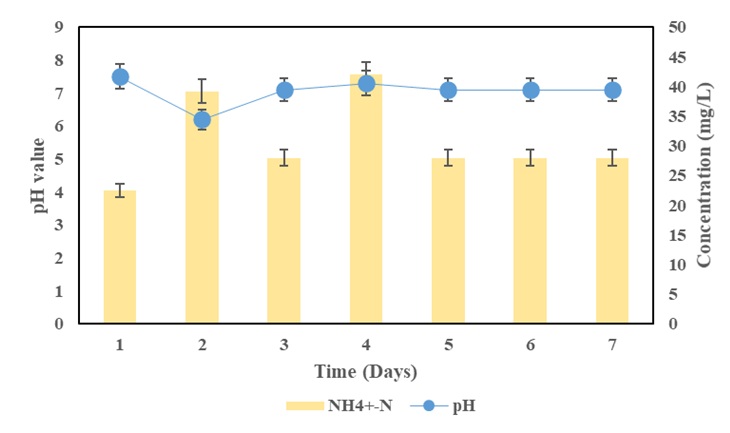
NH4+-N concentration observation alone
It can be seen that the results obtained from the experimental model with high PO-P and Mg RE correspond to the results of previous researches. When Saba et al. (2018) studied that while the P RE reached 94% 31 with the conventional precipitation model, then Van-Giang et al. (2019), and Leng et al. (2020) managed to treat 98 – 99% RE with the upgrade FBHC reactor 15, 32. That is one of the advantages this reactor brings to this works. Besides, the RE of Mg was also higher when adjusting the pH ≤ 8 31. It can be seen that at different pH thresholds, the RE of each criterion will also be different. Accepting the optimal pH fixation to achieve the highest granulation efficiency will lead to the fact that one of the parameters will have a lower RE than the others. It is mentioned here that the RE of NH-N in this study was not high compared to that of Liu et al. (2020) when their pH was 9, they can achieve a RE up to 98.5% 33.
From day 15 to day 24, the RE of Mg and N suddenly decreased due to a lack of balance ratio and available nutrients in the synthesis urine sample. As mentioned earlier, because the pH inside the system was unstable, it caused to the formation of many foreign precipitates at different pH leading to the formation of unnecessary salts with difficult structures to break. That is why during the operation period, periodic withdrawal of precipitate is necessary because otherwise, the amount of precipitate inside the column will form an allowable overload of the FBHC reactor used in this study to operate. Nutrient dose was added as soon as the discharge was changed suddenly. After adding nutrients, the RE started to stabilize from day 16 – 19, and then started to increase again.
Struvite formation
Figure 5 showed the growth of crystal during 24 days. The mass of struvite precipitate obtained in this study was approximately 200 g/m of urine. However, the precipitation in the FBHC reactors seems to occur much more than the working volume of the reactor; hence, weekly taking out the precipitation is needed to avoid the overloading inside the reactor. No granular struvite occurred so far but only fine struvite due to the appearance of foreign ions25.

Crystal growth observation by microscope x10
The presence of foreign ions coming from the nutrients in urine based has a major influence on struvite precipitation while there were more different types of precipitation’s structure occurring among those samples. It is possible to see an effect 34, e.g., on morphologic changes 35, 36, crystal 35 and on precipitation rates22. With different pH conditions, different precipitates will form from components present in urine such as Mg, Ca, NH, PO, CO. Some mentioned ions when combined together under ideal conditions, they will be very difficult to break. These precipitates have a different chemical formula from struvite (Table 3), as long as they get along with each other and increase the foreign precipitation inside the reactor, they will interfere with the formation of struvite, especially granular struvite. The identification of these foreign ions is very important. However, in this study, we only focused on the efficiency of P, N recovery; therefore, in the next study, we will evaluate the influence of foreign ions.
pH condition of other precipitation forms in the reactor at 25oC for synthesis urine
|
Forms |
pH range |
pKsp |
References |
|
MgNH4PO4 |
7 – 11 |
13.26 |
|
|
Mg(OH)2 |
≥ 9.5 |
11.16 |
|
|
MgHPO4 |
< 6 |
5.8 |
|
|
MgCO3 |
< 10.7 |
7.46 – 8.2 |
|
|
Ca3(PO4)2 |
≥ 6 |
25.46 |
|
|
CaHPO4 |
< 7 |
6.6 |
|
|
CaCO3 |
≥ 8.5 |
8.22 – 8.48 |
|
When the K index is low, it shows that the presence of precipitate in impurities will account for the majority when meeting suitable pH and temperature conditions. Since each precipitation form has a different pH value, to avoid the appearance of too many forms during struvite operation, the suggested pH range to get the best quality of struvite is 7.5 – 8. The precipitant must be adjusted and observed carefully to make sure the sample in the reactor is always in this range. Moreover, to have better NH-N RE, pre-treatment by preparing urea solution separately and stored in room condition to let N hydrolyze and let pH increase and stabilize naturally. It can help using less chemicals.
CONCLUSIONS
By using FBHC, high removal efficiency was obtained Mg and PO-P (99%), NH-N (nearly 80%). It can be improved when having sample pre-treatment. An available supplemental source of Mg is required to ensure the molar ratio Mg:P for struvite precipitation in nitrified urine. The precipitation of struvite is less of a concern than engineering the precipitant's fate. This should be investigated further, localized supersaturation may be avoided by using diffuse dosing of magnesium, such as in a fractal manifold, rather than point dosing. Moreover, the potassium content in human urine is also quite high. However, in this study, only nitrogen and phosphorus recovery were focused. Therefore, potassium recovery from urine should also be considered in further research. Foreign ions will be also research to evaluate in future studies.
ACKNOWLEDGEMENT
This research is funded by Vietnam National Foundation for Science and Technology Development (NAFOSTED) under grant number 105.99-2019.27. Ms. Vo Thi Dieu Hien is supported by Vietnam National Foundation for Science and Technology Development (NAFOSTED) under grant number 04/2020/STS01. We acknowledge the support of time and facilities from HCMUT, VNU-HCM for this study.
CONFLICT OF INTEREST
The authors declare that they have no conflict of interest.
AUTHOR CONTRIBUTIONS
Sampling, sample analysis, investigation, software, writing - original draft, writing - review & editing: Bich-Phuong Dang, Thi-Kim-Sinh Nguyen and Quy-Hao Nguyen;
Data curation, conceptualization, methodology, writing - review & editing: Phuong-Thao Nguyen, Cong-Sac Tran, Ngoc-Kim-Qui Nguyen, Van-Giang Le, Mai-Duy-Thong Pham
Supervision, conceived, designed the methodology, writing - review & editing: Thi-Dieu-Hien Vo, Xuan-Thanh Bui.