


Optimizing Electro-Fenton process for removal of atrazine from aqueous solutions using Taguchi method
- Institute for Environment and Resources, Vietnam National University of Ho Chi Minh City, Thu Duc City, Ho Chi Minh City 700000, Vietnam
- Faculty of Environment and Natural Resources, Ho Chi Minh City University of Technology (HCMUT), 268 Ly Thuong Kiet street, District 10, Ho Chi Minh City 700000, Vietnam
- Department of Environmental Science, Saigon University, 273 An Duong Vuong Street, District 5, Ho Chi Minh City 700000, Vietnam
Abstract
The purpose of this study is centered on the removal of atrazine, one of the popular organochlorines in Vietnam, from an aqueous solution, using an electro Fenton process with iron and carbon plated steel electrodes at a batch electro reactor. This study had applied the Taguchi method, one of the most uncomplicated cases of design of experiments involving the minimum number of experiments to be performed within the permissible limit of factors and levels through the Signal to Noise ratio. This study design was conducted with five independent factors: initial pH, current density, Fe2+ concentration, sodium sulfate and reaction time, at a fixed atrazine concentration of 10 mg/L to find the best condition to eliminate atrazine from the solution. The Signal to Noise ratio results illustrates that the initial pH is the most important factor, followed by the reaction time and Fe2+ concentration, while sodium sulfate and current density seem neglectable to the removal of atrazine using electro Fenton process. The optimal Taguchi condition shows that the electro Fenton process reached the best efficiency, approximately 76% atrazine eliminated after 180 min of reaction time at initial pH 3.5, sodium sulfate of 990 mg/L, Fe2+ concentration of 2 mM and current density of 2.22 mA/cm2. Three confirm experiments at optimal test conditions also indicated good agreement with predicted results with small error variation (1.21 - 3.54%). Thus, the relationship between the removal efficiency and operating parameters could be understood. These obtained results highlight the potential of using the electro Fenton process to eradicate or reduce pesticide contaminants. Electron beam also could be one of the pre-treatment techniques to eliminate persistent organic pollutants before biological treatment systems.
Introduction
Agrochemicals (pesticides) has become an essential aspect of modern agriculture, helping to increase yields and crop growth while also ensuring agricultural output stability1. Pests, diseases, and weeds are estimated to account for roughly 25% of global crop output losses that traditional pesticides could control. However, the pesticide contamination of water sources has recently become a serious environmental issue2.
Organochlorines are among the most widely used pesticides to control pests and diseases carriers. In particular, atrazine stands out as high production and worldwide distribution3. Atrazine was first registered in the United States in 1959 and was used as herbicides to control broadleaf and grassy weeds pre-and post-emergence phases. Therefore, possibly these compounds can be found in the environment. In a previous study, the atrazine concentration detected in the surface water is up to 2.1 µg/L that is higher than the limited standard of 0.1 µg/L 4. Phyu, Warne5 found that atrazine was moderately toxic to tropical freshwater daphnia species (48-h-LC 24.6 mg/L). Lerro, Beane Freeman6 also reported that atrazine could be the main responsible for human disease in Iowa, the USA, which required a lot of time for recovery. Therefore, research on appropriate techniques is necessary to preserve the environment from contaminated water.
To degrade pesticides, diverse techniques, i.e., adsorption7, membrane filtration8, 9, coagulation10, biological methods11, and other methods 12, have been successfully used to eliminate pesticide contaminants from wastewater. However, the majority of these techniques are constrained by costs or operational difficulties. As a result, they could not be used for true agrochemical wastewater treatment for real agrochemical wastewater treatment. Recently, the Advanced Oxidation Processes (AOPs) studied focuses on its organic pollutant removal.
AOPs have successfully been applied to remove persistent organic pollutants through reaction with hydroxyl radicals (OH). Among the AOPs, Fenton technology is broadly used in practice because of its cheap and high efficiency with the low toxicity of its reagent (Fe ions and hydrogen peroxide-HO)13.
In the Fenton process, iron (Fe) catalyzes HO into OH, a powerful oxidant capable of decomposing organic pollutants14. The Fenton reagent effectively mineralizes contaminants using cheap materials. Moreover, both Fe and Fe can act as flocculants that further remove the organic pollutants. Because of its high efficiency and simplicity, the Fenton process is regarded as one of the most appealing AOPs used in wastewater treatment.
However, several challenges remain in conventional Fenton-based technologies, including materials for storing corrosive chemicals, i.e., HO, HSO, NaOH, etc. and massive production of sludge formation. As a result, many efforts have been made to develop new technologies that address these issues while still exploiting the Fenton process's powerful oxidation efficiency.
The electrochemical Fenton technique developed lately from the Fenton process is highly attracted among wastewater treatment to remove toxic organic pollutants. In the electrochemical Fenton process, pollutants are eliminated with the Fenton reagent and cathode oxidation across the anode surface. Anode oxidation is unsuccessful at mineralizing most organic contaminants due to the persistent production of organic acids. On the other hand, the electrochemical Fenton might accomplish a spectacular degrading effect of organic pollutants by producing •OH, as shown in equation 115.
Compared to the traditional Fenton, the electrochemical Fenton process could in-situ HO generation that decreased the chemical usage. It has successfully been applied to eliminating organic contamination from wastewaters like dyeing and textile16, 17, pharmaceutical18, coke19, and pesticides20, 21, 22. Even though EF can reduce the organic compounds in aqueous solutions, studies on pesticide contaminants removal are limited.
Aside from deciding on removal strategies, experimental design plays a vital role in reducing both the time and cost associated with wastewater treatment. Taguchi method, a type of experimental design that based on orthogonal arrays and signal to noise ratio (S/N) qualification23, 24, has succeeded in improving, optimizing, and interpreting the factor effects in many treatment processes from wastewater of textile 17, pulp and paper mill 25, oily23, etc. However, the research literature of Taguchi design on the elimination of pesticides using EF method is still insufficient.
Thus, this study aims to investigate the atrazine elimination of EF technology from aqueous solutions. This EF process study was investigated using a variety of parameters, including electrolysis time, current density, initial pH, sodium sulfate (NaSO) and Fe concentration.
Materials and methods
Reagents
Sigma-Aldrich provided atrazine (2-Chloro-4-ethylamino-6-isopropylamino-1,3,5-triazine) with a purity of >98%, which was used without further purification. Biochem in France provided analytical quality ferrous sulfate heptahydrate (FeSO.7HO) and sodium sulfate (NaSO). 10 mg/L of atrazine solution was adjusted to the desired value in experiments using HSO (0.5N) and NaOH (0.1N). The 100 mg/L of atrazine stock solution for EF process was described in our previous procedure12 using deionized water and stored at 5°C; atrazine concentrations of 10 mg/L were obtained by diluting this stock.
Experimental setup and analysis
All experiments were conducted in 4 L electro-Fenton batch reactor, as illustrated in Figure 1. The reactor was involved two iron electrodes anode (Fe: 99.25% - CT) and carbon plated iron cathode, with 146 × 150 × 4 mm dimensions linked in parallel. At the same time, the DC power supply (QJ3003XE, 30V - 3A) was linked to the outer electrodes.

Schematic of the experimental setup for EF treatment. (1) Storage tank, (2) Pump, (3) EF tank, (4) DC power supply, (5) Feed air, (6) carbon plated iron, (7) iron-plated, (8) Product tank
The L27 Taguchi design was conducted with signal-to-noise ratio (S/N) to determine the efficiency of the EF treatment. Five independent parameters, e.g., Fe concentration, NaSO concentration, pH, current density and reaction time with three levels, were evaluated as in Table 1. S/N ratio plots have been used to explore the effect of variables on the response by describing the relationship between the response and the variables. The EF process was subjected to multiple response adjustments to establish the best parameters for maximum atrazine removal efficiency. Minitab 18 was used as a statistical program to conduct the study.
Taguchi design for EF treatment
|
Independent factors |
Level 1 |
Level 2 |
Level 3 |
|
pH |
3 |
3.5 |
4 |
|
Current density (mA/cm2) |
1.11 |
2.22 |
3.33 |
|
Fe2+ concentration (mM) |
0.05 |
0.2 |
1 |
|
Sodium sulfate (mg/L) |
330 |
660 |
990 |
|
Reaction time (min) |
60 |
120 |
180 |
Before experimenting, compressed air was forced into the cathode at a rate of 2.5 L/min for 15 min and maintained throughout the electrolysis. In each run, atrazine solutions were delivered to the feed tank and reaction reactor. The feed pump controlled the appropriate flow rate while HSO changed the initial pH values.
At various time intervals, samples were obtained from the reactor and instantly examined with a syringe equipped with a 0.2 µm filter. The atrazine concentration was determined using High-Performance Liquid Chromatography (HPLC) with the following parameters: wavelength 224 nm, C18 column, length and diameter of column 4.6 × 250 mm, and injection volume of 20 µL. The percentage of atrazine removal was calculated as follows:
Herein, C is the initial atrazine concentration and C is the atrazine concentration at t reaction time.
Results and discussion
Experimental Design Analysis
According to the Taguchi approach, twenty-seven experiment results with 3 levels and 5 factors are indicated in Table 2. The output signal–noise (S/N) ratio from the Taguchi analysis would be evaluated for each test run to determine the distinguishing characteristics between control and signal factors to optimize the pesticide removal procedure. The higher the S/N ratio, the sufficient information there is compared to noisy erroneous data. The "large, the better" of S/N was also used to evaluate the maximize pesticide removal efficiency of the EF process.
Experimental design, the obtained responses
|
Factors | |||||||
|
Run |
pH |
Current density (mA/cm2) |
Fe2+ concentration (mg/L) |
Sodium sulfate (mg/L) |
Reaction time (min) |
Atrazine removal (%) | |
|
Experiment |
Predicted | ||||||
|
1 |
3.0 |
1.11 |
0.05 |
330 |
60 |
36.67 |
34.88 |
|
2 |
3.0 |
1.11 |
0.05 |
330 |
120 |
40.91 |
40.19 |
|
3 |
3.0 |
1.11 |
0.05 |
330 |
180 |
43.73 |
46.23 |
|
4 |
3.0 |
2.22 |
0.20 |
660 |
60 |
48.57 |
51.23 |
|
5 |
3.0 |
2.22 |
0.20 |
660 |
120 |
55.92 |
56.54 |
|
6 |
3.0 |
2.22 |
0.20 |
660 |
180 |
65.87 |
62.58 |
|
7 |
3.0 |
3.33 |
1.00 |
990 |
60 |
41.91 |
42.47 |
|
8 |
3.0 |
3.33 |
1.00 |
990 |
120 |
50.14 |
47.80 |
|
9 |
3.0 |
3.33 |
1.00 |
990 |
180 |
52.05 |
53.82 |
|
10 |
3.5 |
1.11 |
0.20 |
990 |
60 |
33.35 |
34.00 |
|
11 |
3.5 |
1.11 |
0.20 |
990 |
120 |
38.26 |
39.32 |
|
12 |
3.5 |
1.11 |
0.20 |
990 |
180 |
47.05 |
45.35 |
|
13 |
3.5 |
2.22 |
1.00 |
330 |
60 |
22.62 |
22.29 |
|
14 |
3.5 |
2.22 |
1.00 |
330 |
120 |
25.71 |
27.61 |
|
15 |
3.5 |
2.22 |
1.00 |
330 |
180 |
35.20 |
33.64 |
|
16 |
3.5 |
3.33 |
0.05 |
660 |
60 |
25.39 |
25.49 |
|
17 |
3.5 |
3.33 |
0.05 |
660 |
120 |
32.46 |
30.81 |
|
18 |
3.5 |
3.33 |
0.05 |
660 |
180 |
35.30 |
36.84 |
|
19 |
4.0 |
1.11 |
1.00 |
660 |
60 |
16.29 |
16.13 |
|
20 |
4.0 |
1.11 |
1.00 |
660 |
120 |
21.11 |
21.45 |
|
21 |
4.0 |
1.11 |
1.00 |
660 |
180 |
27.67 |
27.48 |
|
22 |
4.0 |
2.22 |
0.05 |
990 |
60 |
17.96 |
17.00 |
|
23 |
4.0 |
2.22 |
0.05 |
990 |
120 |
21.19 |
22.31 |
|
24 |
4.0 |
2.22 |
0.05 |
990 |
180 |
28.49 |
28.34 |
|
25 |
4.0 |
3.33 |
0.20 |
330 |
60 |
19.77 |
19.04 |
|
26 |
4.0 |
3.33 |
0.20 |
330 |
120 |
24.70 |
24.36 |
|
27 |
4.0 |
3.33 |
0.20 |
330 |
180 |
29.32 |
30.39 |
Minitab analysis of the Taguchi design
The effect of the independent factors, i.e., pH, current density, Fe concentration, sodium sulfate, reaction time on atrazine removal, had been investigated. Minitab used the signal-to-noise ratios and means in each level to rank process factors for effective atrazine removal (Table 3).
Response table for S/N ratio
|
Level |
pH |
Current density |
Fe2+ concentration |
Sodium sulfate |
Reaction time |
|
1 |
33.57 |
30.16 |
29.59 |
29.52 |
28.71 |
|
2 |
30.12 |
30.22 |
31.53 |
30.43 |
30.24 |
|
3 |
27.04 |
30.35 |
29.62 |
30.78 |
31.79 |
|
Delta |
6.53 |
0.19 |
1.94 |
1.26 |
3.09 |
|
Rank |
1 |
5 |
3 |
4 |
2 |
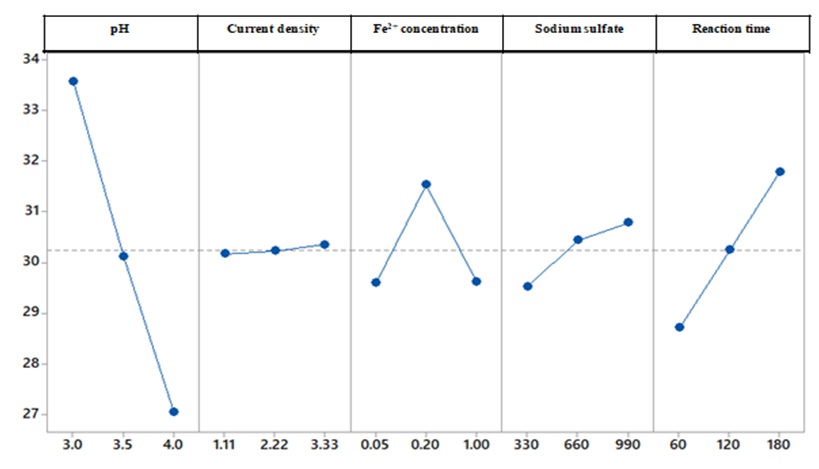
The primary influence of parameters on the S/N for atrazine removal capacity
Besides, the S/N ratio figure also shows how important the influence parameters are in determining the response. Figure 2 shows the mean of S/N ratios for each parameter category corresponding to its’ level. The response with the highest S/N ratio consistently produces the best results. As a result, pH level 1 (pH 3), current density level 3 (2.22 mA/cm), Fe concentration level 2 (0.2 mM), sodium sulfate level 3 (990 mg/L), and reaction time level 3 (180 min) was the optimal combination of parameters for obtaining the maximum value for S/N for pesticide removal effectiveness during EF process. In a previous study of Zhang, Zhang26 EF process mainly influence by pH and reaction time, who stated that the decomposition of 5000 mg/L of COD from landfill leachate to around 2500 mg/L only within 30 min and obtained 1000 mg/L around 75 min at pH approximately 3.5.
Experiments confirm optimal atrazine treatment efficiency
According to the S/N ratio and predicted regression model, the optimal operation treatment using EF to atrazine removal efficiency could be selected as 1st level of pH value (3), 2nd level of current density (2.22 mA/cm), 2nd level of Fe concentration (0.2 mM), 3rd level of sodium sulfate (990 mg/L) and 3rd level of reaction time (180 min). The serial confirmation experiments of the four factors with these values on various reaction times (30 to 180 min) were also conducted. The results of the confirmation experiments in Figure 3 proved to be consistent with predicted optimal results with the highest atrazine removal efficiency around 76.52% and minimal error variation (1.21-3.54%). The obtained results again demonstrated the excellent accuracy of the proposed model or Taguchi approach.

Variation of atrazine removal efficiency on reaction time using EF treatment at optimal conditions: current density = 2.22 mA/cm2; [Fe2+] = 0.2 mM; sodium sulfate = 990 mg/L, V = 3L.
Conclusion
In this study, the oxidation of atrazine was investigated by electro-Fenton (EF) under various operating conditions with Taguchi design. An atrazine degradation efficiency of 76.52% was obtained when the current density of 2.22 mA/cm, Fe dosage of 0.2 mM, sodium sulfate of 990 mg/L with initial atrazine concentration of 10 mg/L during 180 min reaction. An increase in reaction time and sodium sulfate increase the degradation efficiency, whereas excessive Fe concentration and current density can hamper the atrazine elimination. The initial pH is also an essential factor. A pH of 3 was shown to be the ideal pH for the EF process, resulting in a rapid degradation rate. This study found that the EF method can be utilized to pre-treat atrazine-contaminated wastewater before biological treatment.
ACKNOWLEDGMENTS
This research is funded by Vietnam National University HoChiMinh City (VNU-HCM) under grant number C2019-24-01.
Abbreviation
AOPs: Advanced Oxidation Processes
COD: Chemical Oxygen Demand
DC: Direct current
EF: Electro-Fenton
S/N: Signal/Noise
Conflict of interest
The authors declare that there is no conflict of interest regarding the publication of this article
Authors’ contributions
Huynh Ngoc Loan, Hoan Dinh Duong and Bui Manh Ha have made substantial contributions to the work reported in the manuscript.